Echoes of Resonance · by Tolo Aria
The Temples as Portals: What Egypt Transmits
Every return to Egypt opens something new. What the temples were built to receive, hold, and transmit — and what pilgrimage offers when you enter in sequence, not on a tour.
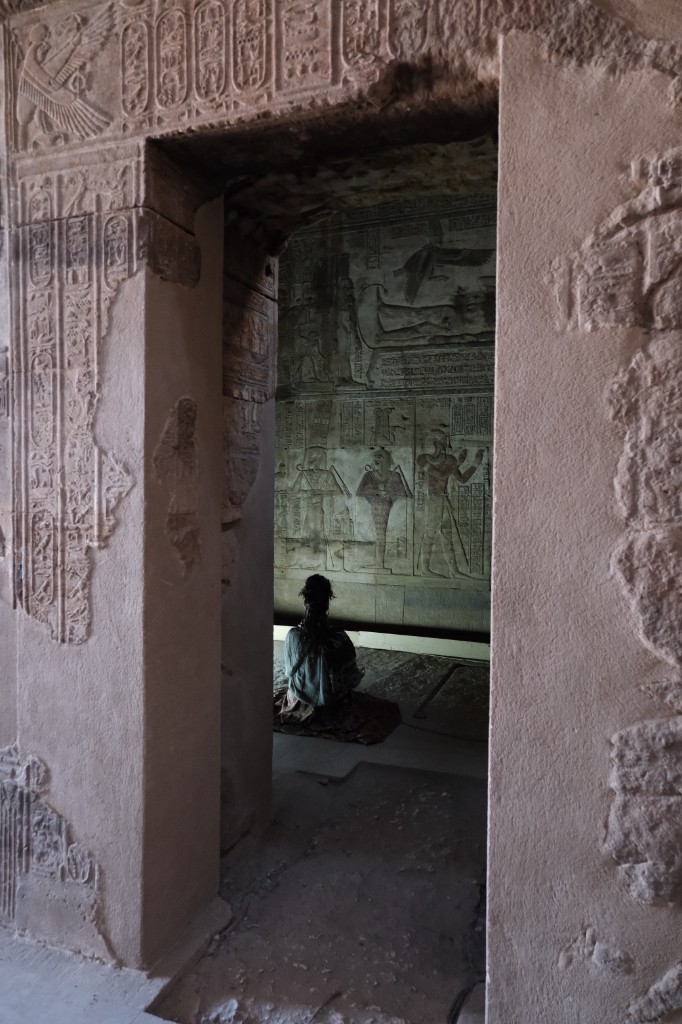
Every time I go to Egypt, it is the first time.
I have walked these temples for years, and still, each visit opens something new. The ancient Egyptians did not build their temples simply to honor the gods. They built them as technology: places designed to receive, hold and transmit.
What a portal is
A portal is a threshold. It is a place where the boundary between one state and another grows thin, where change comes more easily and insight arrives more clearly.
Even modern science has borrowed the word. NASA has described hidden magnetic portals, points where Earth's magnetic field meets the field carried by the sun, opening and closing again and again. In my teaching, the ancient sites sit on places like these: points of concentrated energy along the lines of the Earth. The temples, the standing stones and the earthworks of the ancient world were placed with intention, and their stone, much of it rich in quartz, was chosen with intention too.
The temple as a living body
At Karnak, the sunrise of the winter solstice aligns with the temple's great axis. The temples were built in relationship with the sun, the moon and the stars, and with the transmissions those alignments carry.
When you enter the great hypostyle hall at Karnak, you walk among 134 columns crowned with papyrus and lotus. You are entering the primordial mound, the reeds of creation creating itself. At the heart of the temple lies the Holy of Holies, where priests and priestesses made their offerings. In my teaching, this is the pineal of the temple, the center point where transmissions enter and leave.
Sekhmet, the fiery matrix
In the Temple of Mut, the statues of Sekhmet once numbered in the hundreds. Sekhmet is the fiery power that empowers Ptah's work of creation, the matrix he creates with. When light comes through a portal, I think of her as the fire of true light itself, lighting up the grid.
Edfu, the training ground
At Edfu, the temple of Heru, I receive more than almost anywhere. One of the stories I hold is that after the great flood, the followers of Heru, the Shemsu Hor, gathered here to train priests and priestesses, and that their knowledge later traveled north to Alexandria. Whether you read that as history or as myth, the temple still holds it.
What a transmission is
A transmission is knowledge received through presence rather than words. You sit with your back against an ancient stone, you look down a corridor of columns toward the sanctuary, and something moves through you that no book could give.
The ancient Egyptians understood that the name, the sound and the image carry power. Hu, the divine word, and Sia, divine perception, travel together. The hieroglyphs themselves are transmissions: the Neter, the Djed, the Menat, the name of Asar on the walls of Abydos.
Harmonizing into a higher collective
When you move through the temples in sequence, from Aswan to Cairo or Cairo to Aswan, you are harmonizing yourself into a higher collective. Each temple prepares you for the next. You make an offering before you enter. You arrive, you receive, and you carry it home.
As we evolve, the portals evolve, and we evolve with them.
This is what pilgrimage offers: a return to essence, held in places built for exactly that. Not a tour, an initiation. A remembering of who you are.