Echoes of Resonance · by Tolo Aria
Egypt Temple Geometry & the Nervous System
Egyptian temple geometry, hieroglyphs, and sacred sound work on the nervous system in ways a bus tour cannot. What happens inside the stone on pilgrimage.
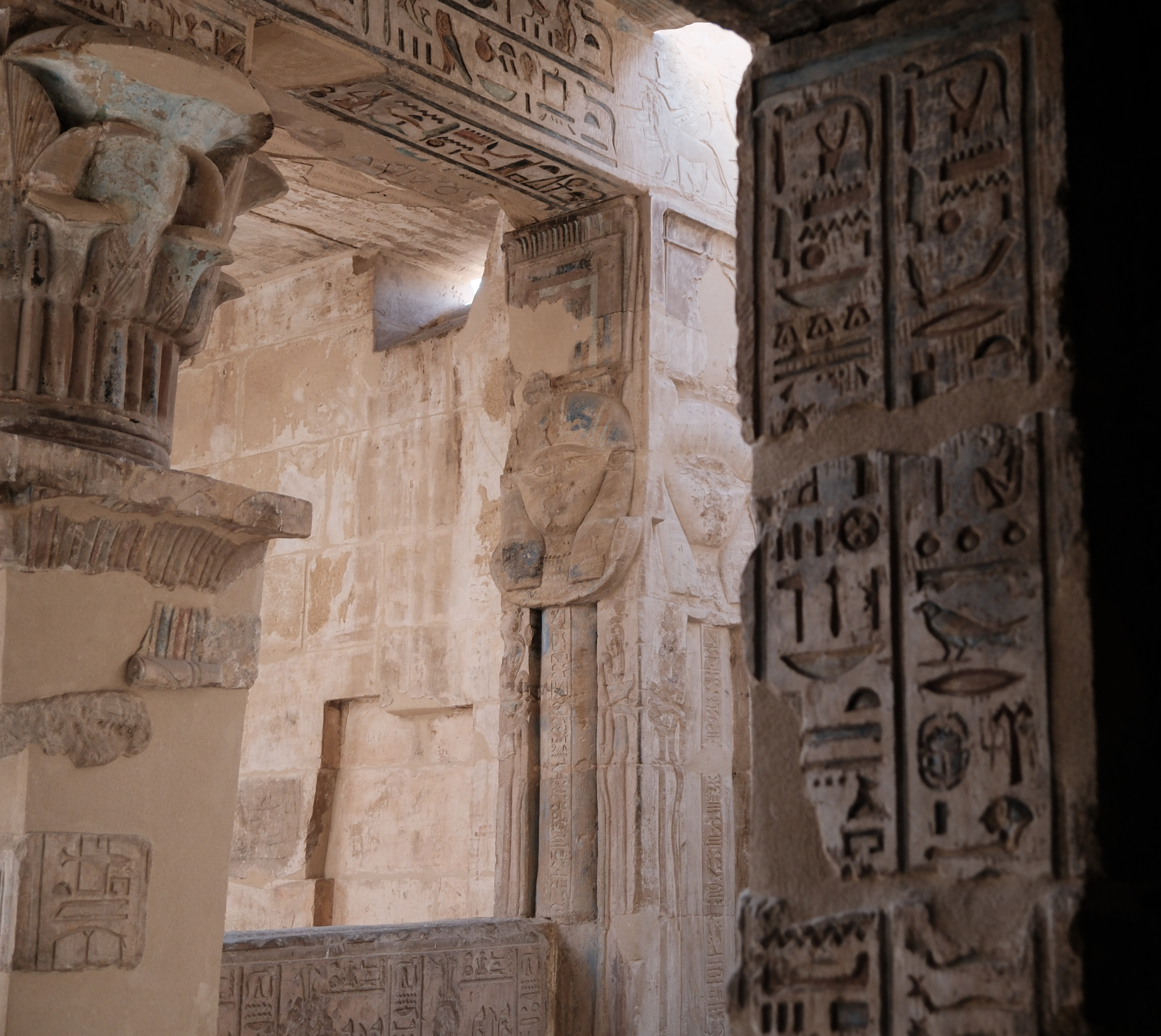
I am standing in a chamber at Dendera when the light moves across the ceiling and the breath in the room changes. No one has explained hieroglyphs yet. No one has named the nervous system. Egyptian temple geometry is already doing its work — proportion, axis, stone holding tone — and the body knows it before the mind catches up.
That is what I want to name for you: not a theory of Egypt, but what happens when sacred sites Egypt still holds are entered with time, silence, and a circle small enough to feel the field.
Egyptian temple geometry and the nervous system
A temple is not a building you look at. It is a sequence you walk. Gate, courtyard, hypostyle hall, inner sanctuary — each threshold asks the body to arrive a little more honestly. When the architecture is aligned to the land and the sky, something in the tissues begins to regulate. Shoulders drop. Breath lengthens. The vigilance that kept you upright through years of over-functioning softens, sometimes for the first time in months.
That is nervous system regulation in plain language: the body receiving a signal that it can stand down without being asked to perform insight on cue.
Proportion, axis, and the walking sequence
The axis of a temple is not decorative. It is direction — spine, pilgrimage, the line from the outer world to what is held inside. You walk it the way you walk a prayer: one foot, then the other, with the geometry doing half the teaching.
Proportion matters because the human body reads space somatically. A chamber built to hold sound and light does something a photograph cannot reproduce. You have to be in it. On an Egypt pilgrimage, we move slowly enough for that reading to happen — passage, in reverence and presence.
Acoustics in stone
Sacred sound healing, in the way I mean it here, is not a playlist laid over a ruin. It is what occurs when voice, drum, or bowl meets stone cut to carry frequency. Karnak holds it differently than Dendera. The Sanctuary of Sekhmet holds it differently again. The walls were built as instruments. When we bring ceremony into those rooms, we meet the design — we do not paste a workshop onto antiquity.
Some pilgrims feel vibration in the sternum. Some feel heat at the base of the skull. Some feel nothing dramatic at all, and only notice three days later that sleep has changed. All of that belongs.
Hieroglyphs beneath conscious reading
The glyphs come later in the passage — after land and architecture have begun their work. Then the walls speak a second language: image and sound held in stone, geometry precise enough to transmit into living tissue.
I am not asking you to become a scholar. I am asking you to notice that hieroglyphs are not captions for tourists. They are shapes cut to move something in the viewer — form, color, light, the angle of the sun at winter solstice through a ceiling aperture. Information encoded for the body as much as the mind.
When habitual patterning loosens, people sometimes say the wall is speaking to them directly. I do not need that to be mystical to take it seriously. I need it to be accurate: the nervous system responds to pattern, and these walls are pattern at scale.
What happens on the ground during an Egypt pilgrimage
An Egypt pilgrimage is not a schedule of famous names checked off from a bus window. It is dawn at the plateau when the site is empty. It is a dahabiya on the Nile when the river sets the pace. It is permission-dependent openings that do not belong on a public itinerary. It is meals together, silence together, and the long work of integration when the temples are done for the day.
We travel in a small circle on purpose. Elemental practice — water, fire, earth, air — is woven through the journey as remembrance. Crystal singing bowls travel with us and are played at the sites. The land participates: stone, river, and sky enter the work with us.
Land geometry and temple time
Temples sit in relationship to the Nile, the desert, and the sky — biogeometry before language. You feel it in the body long before a single glyph asks anything of you. Returning to essence, for many pilgrims, is not an idea. It is what happens when sound and light meet stone at the hour the chamber was built to receive them.
When habitual patterning loosens
Subconscious rewiring, as I use the phrase, is not a slogan. It is the slow unwinding of patterns the body adopted to survive — hyper-vigilance, bracing, the inability to receive. Egypt does not fix that because you flew to Cairo. The field opens a door. What walks through is yours to integrate.
Some people arrive carrying burnout, autoimmune flares, grief that never got a room. The work begins in guided meditation — subconscious rewiring in deep states of consciousness. This journey is held as initiation — a remembrance passage through Egypt.
Subconscious rewiring and what opens the door
What opens the door is rarely a single dramatic moment. It is repetition: entering, breathing, standing in a line of light, letting the group field hold what you usually carry alone. It is also the practice that fully relaxes the body — guided stillness deep enough that the system believes it, attention turned inward without force, brainwave states that open when vigilance finally steps aside. I do not name the modality here because the mechanism matters more than the label: the body must feel safe enough to let go.
That is when deeper material can surface — not because I pull it, but because there is finally room.
Depth over coverage
We optimize for depth — time at the threshold, silence long enough to drop in. Private openings at Karnak, the Sanctuary of Sekhmet, the Great Pyramid when the plateau is empty — including the King's Chamber at Winter Solstice, read more in The Great Pyramid: Egypt as amplifier. Abydos. Hathor at Dendera. Sites along the Nile that remain unnamed here on purpose. Dr. Mohammed Anwer, Egyptologist, travels with the circle for the entire journey — history and practice held side by side, neither standing in for the other.
If you want a beautiful trip with a side of sound bath, there are many good ones. This is a different contract.
I hold the space; you do your own work
I hold the space; the participant does their own work. I guide, and I make room. My assistance is available as often as it is invited, and no more than that.
I will not rewrite you. I will not chase you through your process. I will meet you at the temple gate, in the chamber, on the boat, in the morning when the body is honest — and I will hold the circle while you do what only you can do inside it.
If the call is already in your chest — the one you cannot explain to people who have not stood in stone — read more on the Egypt Winter Solstice journey. For ongoing work between journeys, 1:1 sessions are where we tend the nervous system in daily life.
When you are ready to ask whether this circle is yours, the inquiry form is the next step. No pressure. Only an honest door.