Echoes of Resonance · by Tolo Aria
Siwa Integration Edition: The Oracle, the Oasis, and the Road Through Alexandria
After the temples, some pilgrims feel a call west — to Siwa Oasis, where the Oracle of Amun holds the desert in silence.
When the temples ask for water
Siwa did not arrive as an itinerary first. Several years ago the Oracle came in vision — before I had visited the site — and only then did the map turn west. That story is here.
Fourteen nights inside stone changes you. The Nile, Karnak, Sekhmet, Abydos, the plateau — by the time we return to Cairo, many pilgrims feel full in a way that is difficult to name. Not finished. Full.
That is often when Siwa enters the conversation.
The Siwa Integration Edition is an optional passage after the main Egypt journey — for those who feel the further call west. We move through Alexandria and deep into the Western Desert, to one of the most isolated oases on earth, where the Oracle of Amun once answered questions that shaped empires.
Alexandria: the threshold
Before the desert opens, we pass through Alexandria.
Alexander founded this city in 332 BCE at the edge of Africa and the Mediterranean — a deliberate crossroads where Greek, Egyptian, and later Roman worlds met and layered their mysteries. The Library and the Mouseion are mostly gone, but the feeling remains: a civilization turning its face toward mystery, toward the oracle in the sand.
Alexandria is not a detour. It is a threshold. The Nile journey has been solar, ceremonial, dense with temple architecture. Alexandria offers sea light, open horizon, and the sense of departure — the last urban breath before Siwa.
If you know the feeling of standing at a doorway you are about to walk through, that is Alexandria on this arc — and for those who know where to look, something more. Below the waterfront, the city still holds subterranean chambers, temple foundations beneath the modern street, and sanctuaries that require permission and the right introduction — or simply knowing where the old power still runs. Unfamous in the eyes of media. Powerfully alive for those who have accessed deep remembrance.
We enter Alexandria as threshold — what matters, including places held in confidence for this circle, unnamed here on purpose. The esoteric belongs in the body, in the temple, in the circle — not fully spelled out on a page.
Some cities perform for tourists. Alexandria opens to those who know how to listen beneath the surface.
Siwa: oracle country
Siwa Oasis sits near Egypt's border with Libya, surrounded by the Great Sand Sea. Date palms, olive groves, salt lakes that mirror the sky. Berber Siwan culture — language, dress, hospitality — has endured here for centuries, largely untouched by the pace of the Nile valley.
This isolation is part of why the oracle mattered.
For millennia, pilgrims crossed brutal desert to reach the Temple of Amun at Aghurmi. They came with questions about succession, war, marriage, destiny. The priests of Amun — god of hidden wisdom, later syncretized with Ra as Amun-Ra — delivered answers that could not be obtained anywhere else in the known world.
In 331 BCE, Alexander the Great made the journey. He had conquered Egypt. He had been hailed pharaoh in Memphis. But he came to Siwa seeking something the Nile could not give: confirmation from the oracle that he was truly the son of Amun. The answer he received — whatever its exact words — changed how he understood his own kingship and how the Mediterranean world understood Egypt.
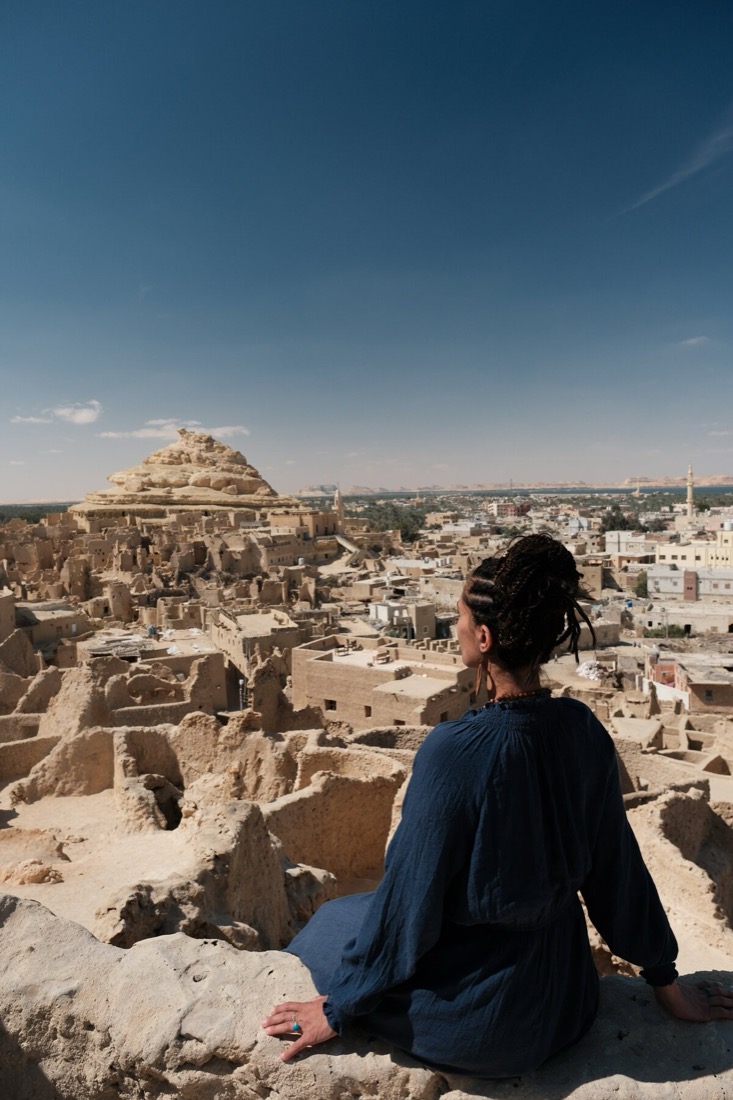
The ruins on the oracle hill at Aghurmi still carry that weight. Not as museum pieces. As atmosphere. A place where the visible world thins.
What we visit
The Siwa Integration Edition is built for integration — the body asking for rest, water, and time after weeks inside ceremony.
**The Oracle of Amun at Aghurmi** — the sacred hill where questions were once asked and answered.
**The Temple of Umm Ubaydah** — once a grand sanctuary; now a solitary column rising from sand, enough to feel the scale of what was here.
**The Fortress of Shali** — the old city built from kershef (salt, mud, palm). A rainstorm in 1926 opened its walls to the sky. At dusk, walking its ruins, you feel how a people have lived with this land for generations.
**The Mountain of the Dead (Gebel al-Mawta)** — rock-cut tombs with painted chambers from the 26th dynasty and beyond. Lineage made visible in stone.
**Sacred springs** — Cleopatra's Bath, the hot springs. Water as medicine after stone. The nervous system softens here in ways temples cannot replicate.
**Salt lakes and the desert edge** — mirrored water, palms, silence. The Great Sand Sea at the rim of the oasis. Time moves differently this far from the Nile.
**Temples of Ra** — solar sanctuaries in a land where the sun and the oracle have always been in conversation.
Laughter belongs here. Community belongs here. So does solitude. Siwa is the exhale — the western integration after the Nile arc.
Who this extension is for
You do not need to know you want Siwa when you inquire about the main journey. Many people feel the pull only after the temples have done their work.
This extension may be for you if:
- You sense that rushing home after initiation would leave something unfinished in the body - The word *oracle* lands somewhere below explanation - You want water, desert, and silence after density - You are drawn to Alexander's road west — or simply to the farthest oasis in Egypt - You trust integration as much as ceremony
You do not need a spiritual résumé. You need sincerity and readiness to receive.
How it fits the Winter Solstice journey
The main Egypt Initiation Journey runs December 20, 2026 through January 3, 2027 — Cairo, Luxor, Aswan, the Nile, private temple access, Winter Solstice on the plateau. The Siwa Integration Edition follows for those who choose it. Exact dates, routing through Alexandria, group size, and investment are confirmed after inquiry.
Some pilgrims will complete the main journey and fly home transformed. Some will feel the further call. Both are honored.
If something in you leaned forward
Siwa has been calling people across the desert for thousands of years. It does not shout. It waits.
If reading this softened something — if Alexandria and the oracle hill feel like the next sentence in a story you did not know you were writing — that is enough to begin.
Inquire about the Egypt Winter Solstice journey and mention Siwa if it is already alive in you. Or schedule an inquiry call and we will listen for what the land is asking.
The temples open the gate. Siwa asks what you will carry through it.